← Todas as provas

Inglês no ENEM 2013: questões e gabarito

10 questões de inglês aplicadas em 2013, com o gabarito oficial e a habilidade que cada uma cobra. Charge, cartaz e tirinha aparecem como saíram no caderno do INEP: questão de imagem não se responde sem a imagem.

Questão 1 de inglês do ENEM 2013

Questão 1Estratégia de leitura
Texto em inglês

After prison blaze kills hundreds in Honduras, UN warns on overcrowding

15 February 2012

A United Nations human rights official today called on Latin American countries to tackle the problem of prison overcrowding in the wake of an overnight fire at a jail in Honduras that killed hundreds of inmates. More than 300 prisoners are reported to have died in the blaze at the prison, located north of the capital, Tegucigalpa, with dozens of others still missing and presumed dead. Antonio Maldonado, human rights adviser for the UN system in Honduras, told UN Radio today that overcrowding may have contributed to the death toll. “But we have to wait until a thorough investigation is conducted so we can reach a precise cause,” he said. “But of course there is a problem of overcrowding in the prison system, not only in this country, but also in many other prisons in Latin America.”

Disponível em: www.un.org. Acesso em: 22 fev. 2012 (adaptado).

Os noticiários destacam acontecimentos diários, que são veiculados em jornal impresso, rádio, televisão e internet. Nesse texto, o acontecimento reportado é a

  1. A)Ocorrência de um incêndio em um presídio superlotado em Honduras.
  2. B)Questão da superlotação nos presídios em Honduras e na América Latina.
  3. C)Investigação da morte de um oficial das Nações Unidas em visita a um presídio.
  4. D)Conclusão do relatório sobre a morte de mais de trezentos detentos em Honduras.
  5. E)Causa da morte de doze detentos em um presídio superlotado ao norte de Honduras.
Ver o gabarito

Resposta correta: A

Por que as outras enganam? A explicação está na página da questão.

Ver a questão 91 de 2013 com a explicação →

ENEM 2013 — enem.dev

Questão 2 de inglês do ENEM 2013

Questão 2Ideia central
Texto em inglês

National Geographic News

Christine Dell’Amore Published April 26, 2010

Our bodies produce a small steady amount of natural morphine, a new study suggests. Traces of the chemical are often found in mouse and human urine, leading scientists to wonder whether the drug is being made naturally or being delivered by something the subjects consumed. The new research shows that mice produce the “incredible painkiller” — and that humans and other mammals possess the same chemical road map for making it, said study co-author Meinhart Zenk, who studies plant-based pharmaceuticals at the Donald Danforth Plant Science Center in St. Louis, Missouri.

Disponível em: www.nationalgeographic.com. Acesso em: 27 jul. 2010.

Ao ler a matéria publicada na National Geographic, para a realização de um trabalho escolar, um estudante descobriu que

  1. A)Os compostos químicos da morfina, produzidos por humanos, são manipulados no Missouri.
  2. B)Os ratos e os humanos possuem a mesma via metabólica para produção de morfina.
  3. C)A produção de morfina em grande quantidade minimiza a dor em ratos e humanos.
  4. D)Os seres humanos têm uma predisposição genética para inibir a dor.
  5. E)A produção de morfina é um traço incomum entre os animais.
Ver o gabarito

Resposta correta: B

Por que as outras enganam? A explicação está na página da questão.

Ver a questão 92 de 2013 com a explicação →

ENEM 2013 — enem.dev

Questão 3 de inglês do ENEM 2013

Questão 3Objetivo do textoInferência pelo contexto
Texto em inglês

Steve Jobs: A Life Remembered 1955-2011

Readersdigest.ca takes a look back at Steve Jobs, and his contribution to our digital world.

CEO. Tech-Guru. Artist. There are few corporate figures as famous and well-regarded as former-Apple CEO Steve Jobs. His list of achievements is staggering, and his contribution to modern technology, digital media, and indeed the world as a whole, cannot be downplayed. With his passing on October 5, 2011, readersdigest.ca looks back at some of his greatest achievements, and pays our respects to a digital pioneer who helped pave the way for a generation of technology, and possibilities, few could have imagined.

Disponível em: www.readersdigest.ca. Acesso em: 25 fev. 2012

Informações sobre pessoas famosas são recorrentes na mídia, divulgadas de forma impressa ou virtualmente. Em relação a Steve Jobs, esse texto propõe

  1. A)Expor as maiores conquistas da sua empresa.
  2. B)Descrever suas criações na área da tecnologia.
  3. C)Enaltecer sua contribuição para o mundo digital.
  4. D)Lamentar sua ausência na criação de novas tecnologias.
  5. E)Discutir o impacto de seu trabalho para a geração digital.
Ver o gabarito

Resposta correta: C

Por que as outras enganam? A explicação está na página da questão.

Ver a questão 93 de 2013 com a explicação →

ENEM 2013 — enem.dev

Questão 4 de inglês do ENEM 2013

Questão 4Propaganda e cartaz
Texto em inglês

Do one thing for diversity and inclusion

The United Nations Alliance of Civilizations (UNAOC) is launching a campaign aimed at engaging people around the world to Do One Thing to support Cultural Diversity and Inclusion. Every one of us can do ONE thing for diversity and inclusion; even one very little thing can become a global action if we all take part in it.

Simple things YOU can do to celebrate the World Day for Cultural Diversity for Dialogue and Development on May 21.

1\. Visit an art exhibit or a museum dedicated to other cultures. 2\. Read about the great thinkers of other cultures. 3\. Visit a place of worship different than yours and participate in the celebration. 4\. Spread your own culture around the world and learn about other cultures. 5\. Explore music of a different culture.

There are thousands of things that you can do, are you taking part in it?

UNITED NATIONS ALLIANCE OF CIVILIZATIONS.

Disponível em: www.unaoc.org. Acesso em: 16 fev. 2013 (adaptado).

Internautas costumam manifestar suas opiniões sobre artigos on-line por meio da postagem de comentários. O comentário que exemplifica o engajamento proposto na quarta dica da campanha apresentada no texto é:

  1. A)“Lá na minha escola, aprendi a jogar capoeira para uma apresentação no Dia da Consciência Negra.”
  2. B)“Outro dia assisti na TV uma reportagem sobre respeito à diversidade. Gente de todos os tipos, várias tribos. Curti bastante.”
  3. C)“Eu me inscrevi no Programa Jovens Embaixadores para mostrar o que tem de bom em meu país e conhecer outras formas de ser.”
  4. D)“Curto muito bater papo na internet. Meus amigos estrangeiros me ajudam a aperfeiçoar minha proficiência em língua estrangeira.”
  5. E)“Pesquisei em sites de culinária e preparei uma festa árabe para uns amigos da escola. Eles adoraram, principalmente, os doces!”
Ver o gabarito

Resposta correta: C

Por que as outras enganam? A explicação está na página da questão.

Ver a questão 94 de 2013 com a explicação →

ENEM 2013 — enem.dev

Questão 5 de inglês do ENEM 2013

Questão 5Charge e cartumInferência pelo contexto
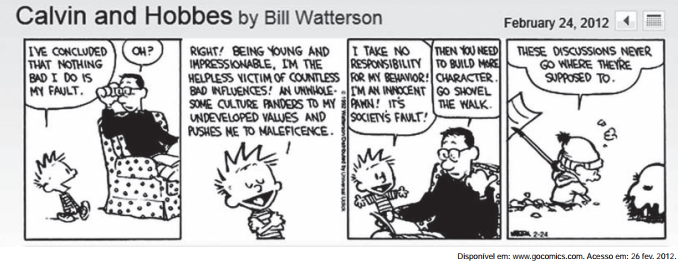
tirinha Calvin and Hobbes, de Bill Watterson, publicada em 24 de fevereiro de 2012, em quatro quadros. Quadro 1 — Calvin, ao pai que lê o jornal na poltrona: "I've concluded that nothing bad I do is my fault." O pai: "Oh?" Quadro 2 — Calvin: "Right! Being young and impressionable, I'm the helpless victim of countless bad influences! An unwholesome culture panders to my undeveloped values and pushes me to maleficence." Quadro 3 — Calvin: "I take no responsibility for my behavior! I'm an innocent pawn! It's society's fault!" O pai: "Then you need to build more character. Go shovel the walk." Quadro 4 — Calvin, do lado de fora, com a pá na neve, para Haroldo: "These discussions never go where they're supposed to."
Bill Watterson

Disponível em: www.gocomics.com. Acesso em: 26 fev. 2012.

A partir da leitura dessa tirinha, infere-se que o discurso de Calvin teve um efeito diferente do pretendido, uma vez que ele

  1. A)Decide tirar a neve do quintal para convencer seu pai sobre seu discurso.
  2. B)Culpa o pai por exercer influência negativa na formação de sua personalidade.
  3. C)Comenta que suas discussões com o pai não correspondem às suas expectativas.
  4. D)Conclui que os acontecimentos ruins não fazem falta para a sociedade.
  5. E)Reclama que é vítima de valores que o levam a atitudes inadequadas.
Ver o gabarito

Resposta correta: C

Por que as outras enganam? A explicação está na página da questão.

Ver a questão 95 de 2013 com a explicação →

ENEM 2013 — 2º dia, Caderno 5 (Amarelo), questão 91 (opção inglês). PDF oficial do INEP.

Questão 6 de inglês do ENEM 2013

Questão 6Estratégia de leitura
placa de sinalização urbana, em preto e branco, com o pictograma de um reboque puxando um carro. O texto da placa:
Texto em inglês

WARNING PERMIT PARKING ONLY VEHICLES WITHOUT VALID PERMITS WILL BE TOWED AT OWNER'S EXPENSE

Disponível em: www.seton.com. Acesso em: 28 fev. 2012.

Placas como a da gravura são usadas para orientar os usuários de um espaço urbano. Essa placa, especificamente, tem a função de avisar que somente

  1. A)as despesas feitas com estacionamento são deduzidas.
  2. B)os donos de carro entram no estacionamento do parque.
  3. C)o proprietário autoriza a validação do estacionamento.
  4. D)os rebocadores precisam de permissão para entrar no local.
  5. E)os veículos autorizados podem estacionar naquela área.
Ver o gabarito

Resposta correta: E

Por que as outras enganam? A explicação está na página da questão.

Ver a questão 91 de 2013 com a explicação →

ENEM 2013 2ª aplicação — 2º dia, Caderno 6 (Cinza), questões 91 a 95 (opção inglês). PDF oficial do INEP.

Questão 7 de inglês do ENEM 2013

Questão 7Estratégia de leitura
Texto em inglês

The art of happiness

Nearly every time you see him, he's laughing or at least smiling. And he makes everyone else around him feel like smiling. He's the Dalai Lama, the spiritual and temporal leader of Tibet, a Nobel Prize winner, and an increasingly popular speaker and statesman. Why is he so popular? Even after spending only a few minutes in his presence you can't help feeling happier. If you ask him if he's happy, even though he's suffered the loss of his country, the Dalai Lama will give you an unconditional yes. What's more, he'll tell you that happiness is the purpose of life, and that "the very motion of our life is towards happiness". How to get there has always been the question. He's tried to answer it before, but he's never had the help of a psychiatrist to get the message across in a context we can easily understand.

LAMA, D.; CUTLER, H. The Art of Happiness: a handbook for living. Putnam Books, 1998.

Pelo título e pela sinopse do livro de Lama e Cutler, constata-se que o tema da obra é

  1. A)o sucesso dos autores no Tibet.
  2. B)a busca da felicidade no cotidiano.
  3. C)o Prêmio Nobel recebido por Lama.
  4. D)a liderança de Dalai Lama no Tibet.
  5. E)a discussão de Lama e seu psiquiatra.
Ver o gabarito

Resposta correta: B

Por que as outras enganam? A explicação está na página da questão.

Ver a questão 92 de 2013 com a explicação →

ENEM 2013 2ª aplicação — 2º dia, Caderno 6 (Cinza), questões 91 a 95 (opção inglês). PDF oficial do INEP.

Questão 8 de inglês do ENEM 2013

Questão 8Estratégia de leitura
Texto em inglês

Cyberbullying is harassment through electronic means such as telephone text messages, social media such as Facebook and Twitter or online blogs and bulletin boards. In normal bullying, students are given a daily break from the torment as bully and victim each go to their separate homes. But for victims of cyberbullying, there is no reprieve, as the abuse enters into their private lives. In the US, there are at least 44 states that have anti-bullying laws on the books. While only six of them use the actual word "cyberbullying", 31 others have laws that specifically mention "electronic harassment".

Prosecution in the UK is a little more difficult. While all schools are required to have anti-bullying policies in place, cyberbullying itself is not named as a criminal offence. Offenders in the UK would have to be charged under various other laws, including the Protection from Harassment Act of 2003. This makes prosecution much more difficult.

Authorities agree that in order to stop cyberbullying, there has to be parental involvement. Parents need to be vigilant about their children's access to technology. They should monitor their children's use of social media, especially children under the age of 14. Bullies are not going to simply disappear, but parents can go a long way in protecting their children from being bullied.

Go! English, ano II, n. 14 (fragmento).

De acordo com o texto, nos Estados Unidos, alguns estados têm leis específicas para assédio via meios eletrônicos. Já no Reino Unido, a instauração de processos contra praticantes de cyberbullying é mais difícil porque

  1. A)as vítimas precisam recorrer a outras leis existentes, pois o cyberbullying não é considerado crime.
  2. B)as leis que regulamentam o uso da internet e dos meios eletrônicos de comunicação são inexistentes.
  3. C)os pais das vítimas não têm interesse em denunciar os agressores de seus filhos às autoridades competentes.
  4. D)os estudantes com idade inferior a 18 anos não podem sofrer acusações de prática de cyberbullying ou bullying.
  5. E)as leis como a de Proteção contra Atos de Assédio de 2003 estabelecem que o cyberbullying não é crime.
Ver o gabarito

Resposta correta: A

Por que as outras enganam? A explicação está na página da questão.

Ver a questão 93 de 2013 com a explicação →

ENEM 2013 2ª aplicação — 2º dia, Caderno 6 (Cinza), questões 91 a 95 (opção inglês). PDF oficial do INEP.

Questão 9 de inglês do ENEM 2013

Questão 9Charge e cartumObjetivo do texto
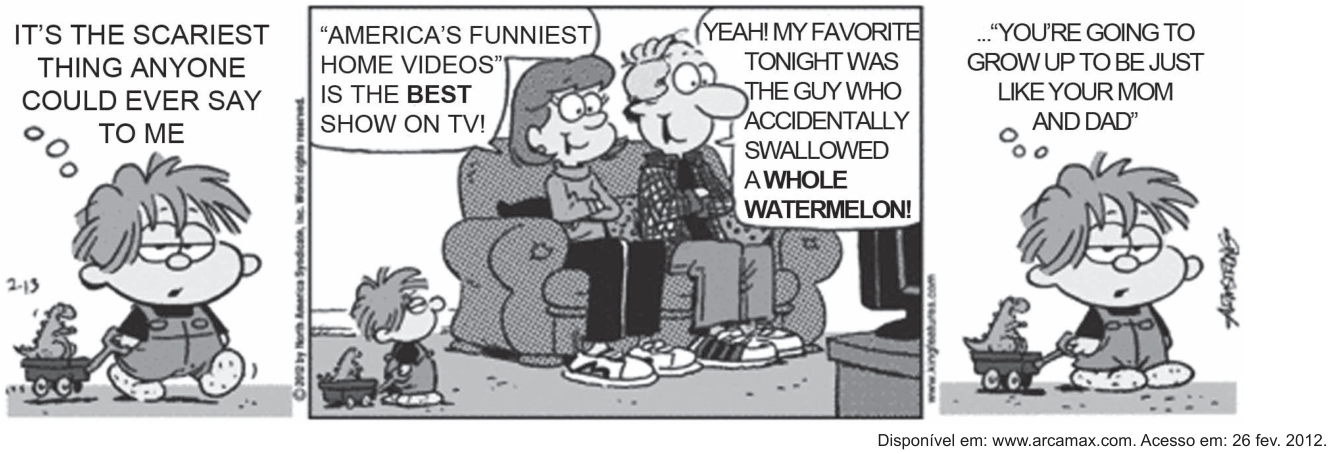
tirinha em quatro quadros. Quadro 1 — um menino puxando um carrinho pensa: "It's the scariest thing anyone could ever say to me". Quadro 2 — os pais, no sofá, assistem à televisão; o pai diz: "'America's Funniest Home Videos' is the BEST show on TV!" Quadro 3 — a mãe completa: "Yeah! My favorite tonight was the guy who accidentally swallowed a WHOLE WATERMELON!" Quadro 4 — o menino, de volta ao carrinho, com expressão assustada, pensa: "...'You're going to grow up to be just like your mom and dad'".

Disponível em: www.arcamax.com. Acesso em: 26 fev. 2012.

Tirinhas são construídas a partir de contextos sociais e podem promover reflexões diversas. Essa tirinha provoca no leitor uma reflexão acerca da

  1. A)divisão de espaço com os pais.
  2. B)perda da atenção dos pais.
  3. C)submissão aos pais.
  4. D)ausência dos pais.
  5. E)semelhança com os pais.
Ver o gabarito

Resposta correta: E

Por que as outras enganam? A explicação está na página da questão.

Ver a questão 94 de 2013 com a explicação →

ENEM 2013 2ª aplicação — 2º dia, Caderno 6 (Cinza), questões 91 a 95 (opção inglês). PDF oficial do INEP.

Questão 10 de inglês do ENEM 2013

Questão 10Objetivo do texto
Texto em inglês

Movie: Hijras – The Third Gender

Director: Devika Urvashi Bhisé Duration: 29 minutes

Hijras are the outcastes of Indian society and live on its fringes. These eunuchs (originally only castrated males) were once employed by sultans and maharajas to guard the women in their harems. Now shunned by society, they are treated with less respect than the Dalits, or untouchables. Considered neither men nor women, Hijras have no constitutional rights. Currently, there is an ongoing debate in India regarding whether or not they should be granted the status of a third gender.

Most hijras are genetically born as men, but believe they are women within. The rest are hermaphrodites with some abnormality in genitalia. For those born men, becoming a hijra is a painful process that involves removing the entire genitalia in a secret ceremony that is often undergone without any anesthetic.

Currently, most hijras have only three ways in which they can make a living: prostitution, begging, and as performing shamans removing bad luck and/or spells from suspicious Indian households. Sex work is one of the only options for hijras because there are few employment opportunities available to them. Hijras are most commonly seen knocking on car windows, begging for money at stoplights. Although hijras are feared for their dissimilarities, they are also revered for their alleged mystical abilities. Most Indian families seek their blessings during any auspicious ceremony such as a birth, a wedding, or the building of a new house.

As pariahs of society, they are subjected to prejudice that is often translated into verbal abuse, humiliation, extreme discrimination, and violence in public as well as private venues. I have documented a short film to create awareness of the plight of this segment of society and allow their voices to be heard. I was privileged to share this community's inner life and have tried to capture its stark reality as a friend rather than a voyeur. The filming took place from June 2008 to September 2008 in various cities and locations in India.

Disponível em: www.engendered.org. Acesso em: 25 fev. 2012.

O filme Hijras – The Third Gender tem como objetivo chamar atenção para a situação vivida por um segmento da sociedade indiana, os hijras. De acordo com o que se capta dessas vozes no filme e do que se lê no texto, esse segmento reivindica

  1. A)os mesmos direitos dos dalits, ou intocáveis.
  2. B)o direito constitucional de sair da marginalidade.
  3. C)um processo mais humano de mudança de sexo.
  4. D)a regulamentação de suas atuais funções sociais.
  5. E)o reconhecimento de suas habilidades místicas.
Ver o gabarito

Resposta correta: B

Por que as outras enganam? A explicação está na página da questão.

Ver a questão 95 de 2013 com a explicação →

ENEM 2013 2ª aplicação — 2º dia, Caderno 6 (Cinza), questões 91 a 95 (opção inglês). PDF oficial do INEP.

E agora, o que fazer com isso

Fazer a prova e conferir o gabarito não é estudar. O que vira nota é entender por que você marcou a errada.